
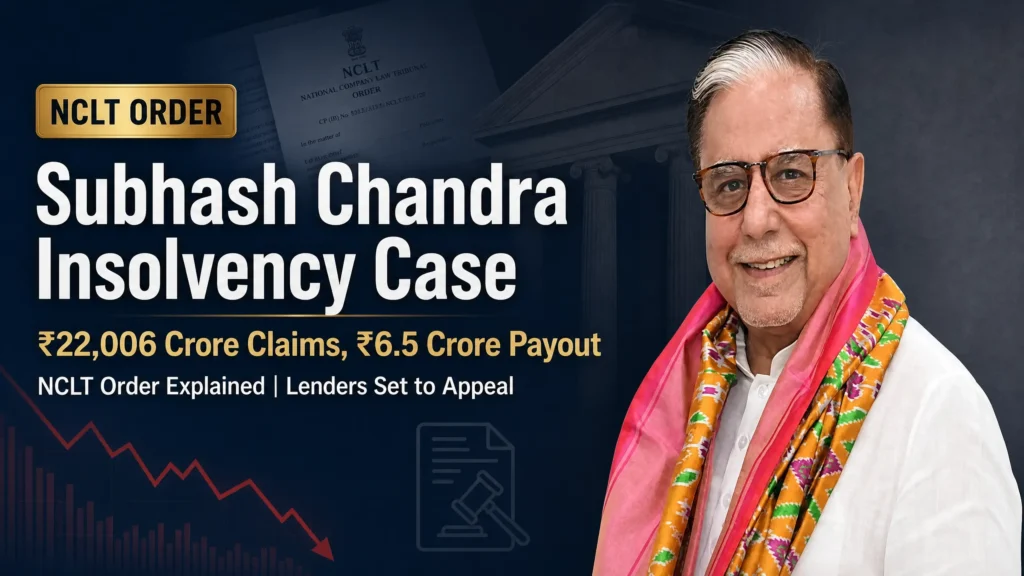
An order passed by the National Company Law Tribunal on August 25, 2026, has put Zee Group founder and Essel Group chairman emeritus Subhash Chandra back in the headlines, and reignited a wider debate about how India’s insolvency law treats personal guarantors. The tribunal approved a repayment plan under which Chandra will pay creditors a combined Rs 6.5 crore, made up of Rs 6.25 crore to creditors and a further Rs 25 lakh towards insolvency resolution process costs, against admitted claims of Rs 22,006.57 crore. On paper, that works out to a recovery of roughly 0.03 per cent, or a haircut of close to 99.97 per cent, and it is that gap between the two numbers that has driven most of the coverage around this case.
But the case is more layered than a single headline figure suggests. The plan was cleared by a majority of creditors, a smaller group of banks led by HDFC Bank and LIC Housing Finance are preparing to challenge it, banks have separately alleged that entities holding a majority of the votes cast are undisclosed associates of Chandra, and Chandra’s office has issued an on record denial naming his brother’s family as the actual owners of those entities. Government sources have also pushed back on the 99.97 per cent framing itself, arguing it does not reflect the complete picture.
Here is a complete, plain language breakdown of what the order says, how creditors voted, what each side is claiming, and what happens next.
Quick Facts: Subhash Chandra Insolvency Case
| Detail | Info |
|---|---|
| Who | Subhash Chandra, founder of Zee Group and chairman emeritus of Essel Group |
| Nature of Case | Personal insolvency proceedings against Chandra as a personal guarantor, not a corporate insolvency of Essel or Zee companies |
| NCLT Order Date | August 25, 2026, New Delhi bench |
| Total Admitted Claims | Rs 22,006.57 crore |
| Approved Payment From Chandra | Rs 6.25 crore to creditors plus Rs 25 lakh towards process costs, about Rs 6.5 crore in total |
| Additional Amount From Borrower Companies | About Rs 1,494 crore, separately, according to government sources |
| Approximate Recovery Rate | About 0.03 per cent, described as a haircut of nearly 99.97 per cent |
| Creditor Vote | 80.81 per cent in favour, 19.19 per cent against |
| Who Voted Against | HDFC Bank, LIC Housing Finance, Canara Bank, Axis Bank, RBL Bank and Union Bank, according to government sources |
| Central Allegation | Banks allege entities holding 61.78 per cent of votes cast are undisclosed associates of Chandra |
| Chandra’s Response | Denies personal borrowing, disputes the associate entity claim, and says objecting creditors are owed Rs 3,992 crore, not Rs 22,006 crore |
| Appeal Status | HDFC Bank and LIC Housing Finance are reported to be preparing an appeal before the NCLAT |
How the Subhash Chandra Insolvency Case Began
The case traces back to a Rs 170 crore loan taken by Vivek Infracon Private Limited, for which Chandra had given a personal guarantee. When that loan turned bad, Indiabulls Housing Finance, since renamed Sammaan Capital, moved against Chandra and filed an insolvency application in 2022. An earlier attempt to settle the matter did not go through. After the Supreme Court upheld the relevant provisions of the Insolvency and Bankruptcy Code in November 2023, the personal insolvency proceedings against Chandra were revived, and the NCLT formally admitted them in April 2024.
It is worth being precise about what this case actually covers. The proceedings are against Chandra in his individual capacity as a guarantor, not against Essel Group or Zee as corporate entities, and not against the companies that originally borrowed the money. Government sources have stressed that the Rs 22,006.57 crore figure represents claims admitted against Chandra as guarantor for loans taken by several Essel and Zee linked companies, rather than money he personally borrowed, and that creditors’ separate claims against those borrowing companies and their assets remain unresolved and untouched by this order.
The matter eventually reached the NCLT’s Delhi bench, where two members returned a split verdict. It was then referred to a third, judicial member, Nilesh Sharma, who approved the settlement under Section 114 of the Insolvency and Bankruptcy Code. Because the bench was split, the case now goes back for a formal order in line with the majority view, as required under Section 419(5) of the Companies Act, 2013.
Also Read >>>> HDFC Bank CEO Sashidhar Jagdishan Not Seeking Reappointment: Stock Jumps 3%
The Numbers: How Rs 22,006 Crore Became a Rs 6.5 Crore Payout
The comparison that has drawn the most attention is between the Rs 22,006.57 crore in admitted claims and the Rs 6.5 crore Chandra will pay personally. Several details help explain, though not necessarily settle, that gap.
First, the approved plan is not the only money creditors expect to receive. Government sources have said that separately from Chandra’s own Rs 6.25 crore contribution, about a further Rs 1,494 crore is expected to come from the companies that originally borrowed the funds, since those companies, not Chandra, were the actual borrowers.
Second, government sources argue that describing this as a 99.97 per cent loss on Rs 22,000 crore of bank lending is misleading, because the reduction applies specifically to what can be recovered from Chandra as an individual guarantor, not to the underlying corporate loans as a whole. According to figures cited by Chandra’s office, the companies for which he had provided guarantees had collectively borrowed close to Rs 45,000 crore as of January 2019, of which about Rs 43,000 crore has already been repaid to lenders, with the remaining borrower entities said to have committed to clearing any balance due.
Third, Chandra has contested the headline Rs 22,006.57 crore figure itself. He has said that the claim raised specifically by creditors who are objecting to the plan comes to Rs 3,992 crore, well short of the widely cited Rs 22,000 crore figure that covers all admitted claims across every creditor, including those who voted in favour. Of that Rs 3,992 crore, Chandra’s office says Rs 620 crore has already been settled and a further Rs 1,063 crore is being offered by the borrower companies.
Chandra has defended the size of the payout by pointing to his own declared net worth, which stood at Rs 31.79 crore in 2024, including a residential property worth around Rs 25 crore. Creditors, however, have flagged a sharp decline from older net worth certificates that placed his wealth at about Rs 45,888 crore in 2017 and Rs 40,562 crore in 2018, and have used that gap to argue for closer scrutiny of his current assets. Responding publicly to the criticism that followed the order, Chandra said, “Started With Rs 17, Will Get Back On My Feet.”
How the Creditors Voted
The repayment plan was approved with 80.81 per cent of votes cast in favour, against 19.19 per cent opposed. Every creditor that voted against the plan was a bank or a housing finance company. Government sources have named HDFC Bank, LIC Housing Finance, Canara Bank, Axis Bank, RBL Bank and Union Bank as the dissenting lenders, with individual vote shares of 3.17 per cent for HDFC Bank, 6.09 per cent for LIC Housing Finance and 1.60 per cent for Canara Bank. HDFC Bank has separately said in its own statement that its admitted claim, a facility it inherited from HDFC Ltd after their merger, amounted to 3.2 per cent of the total stated claim.
The NCLT’s own reasoning, as reported, was that resolving Chandra’s personal insolvency and allowing him to move forward would ultimately give objecting creditors a better chance of recovering their dues directly from the companies that had originally borrowed the money, and that the combined objections of the dissenting lenders were not enough to override a plan that already had majority creditor support.
Also Read >>>> ChatGPT Ads Launch in India: Who Sees Them, Who Doesn’t
The Associate Entities Allegation
Separately from the vote count itself, banks have raised a more serious objection, filed through IDBI Trusteeship Services, alleging that a group of entities that together cast 61.78 per cent of the votes are in fact undisclosed associates of Chandra rather than independent creditors. The entities named in this allegation are Veena Investments Private Limited, Direct Media Distribution Ventures Private Limited, World Crest Advisors LLP, Lemonade Capital Advisors LLP and Corpcall Capital Advisors LLP, with individually disclosed vote shares of 28.49 per cent for World Crest, 16.85 per cent for Lemonade, 10.30 per cent for Corpcall and 4.99 per cent for Veena Investments. A separate voting entity, Catalyst Trusteeship acting for CINDA FPI, held 11.85 per cent and also favoured the plan, but has not been named as part of this associate entity allegation.
According to the objection, Direct Media Distribution Ventures and World Crest Advisors are subsidiaries of Veena Investments, which banks allege is controlled by Sushila Devi Goel, wife of Jawahar Goel, who is Chandra’s brother. The claims filed by Lemonade Capital Advisors and Corpcall Capital Advisors are said to rest on guarantee deeds allegedly executed by Chandra in connection with financing taken by another group entity, Churu Enterprises LLP, and the objection points out that partners of these two firms are also directors in companies listed as other related parties in Veena Investments’ own consolidated financial statements for 2020 to 2021. Banks have further contended that these guarantees were invoked only after an interim moratorium had already taken effect, which they argue makes the invocation legally invalid, and have alleged that the arrangement amounts to a collusive attempt to create artificial liabilities in favour of related parties.
A related concern flagged in the order involves smaller individual claims that were admitted without documentary evidence, based only on assertions that the claimants had worked for Chandra or his companies and that he had verbally promised them financial assistance. The NCLT ultimately directed that two such individuals be removed from the creditor list, with their allocated share redistributed among the remaining eligible creditors.
Subhash Chandra’s Office Responds
Chandra’s office has firmly denied both the scale of the claims and the associate entity allegation. On the money itself, the office maintains that Chandra never personally borrowed from any of the lenders named in the case and that he only ever signed personal guarantees on behalf of group companies. On the ownership question, Chandra’s office has said that the entities in dispute belong to the family of Jawahar Goel following a separation of business interests between the two brothers dating back to 2008 and 2009, that this separation was properly disclosed to stock exchanges and regulators at the time, and that under the definition of associate entity written into the Insolvency and Bankruptcy Code, the entities in question do not qualify as associates of the group. Neither the banks’ allegation nor Chandra’s denial has been independently adjudicated as fact in the reporting reviewed for this article, and both should be read as the competing positions of the two sides in an ongoing dispute.
HDFC Bank and Other Lenders Plan to Appeal
HDFC Bank has said in a statement that it opposed and voted against the repayment plan and is exploring an appeal before the National Company Law Appellate Tribunal, though it had not filed one as of its statement. According to a report by Economic Times, both LIC Housing Finance and HDFC Bank now intend to challenge the NCLT’s order at the NCLAT, and LIC Housing Finance is also said to be considering a separate approach to its regulator, the National Housing Bank. Until any appeal is decided, the approved plan stands, and under the Insolvency and Bankruptcy Code, dissenting creditors remain bound by its terms in the meantime.
What This Means for India’s Insolvency Law
Government sources have been unusually vocal in this case, arguing that it should be seen as an exceptional personal guarantor resolution rather than a representative example of how the Insolvency and Bankruptcy Code performs generally. In support of that, they have pointed to broader data showing creditors recovered about Rs 4.32 lakh crore through resolution plans approved up to March 2026, equal to 116.85 per cent of liquidation value and 94.56 per cent of fair value, along with more than 32,000 cases involving assets worth close to Rs 14 lakh crore that were settled even before formal admission into insolvency proceedings, which they describe as evidence of the law’s deterrent effect. They have also cited a decline in the banking system’s net non performing assets, from 5.94 per cent in March 2018 to 0.48 per cent in September 2025, or from about Rs 5.2 lakh crore to roughly Rs 94,000 crore in absolute terms.
What Happens Next
For now, the approved plan requires Chandra to pay Rs 6.25 crore to creditors and Rs 25 lakh towards process costs, while the companies that originally borrowed the money are expected to separately contribute about Rs 1,494 crore. Creditors’ claims against the Essel and Zee companies and their underlying assets remain separate from this order and are still unresolved. HDFC Bank and LIC Housing Finance are expected to pursue an appeal before the NCLAT, and the associate entity allegation and the questions raised over Chandra’s declared net worth are both likely to remain contested points as the matter moves forward.
This article is a summary of reported news coverage and disclosed tribunal proceedings as they stood at the time of writing. It is not legal or financial advice, the allegations described above are attributed claims that have not been independently adjudicated in the sources reviewed, and readers seeking a definitive legal or financial view should consult the official NCLT order and a qualified professional.
Frequently Asked Questions (FAQs)
1. What is the Subhash Chandra insolvency case about?
It is a personal insolvency case under India’s Insolvency and Bankruptcy Code against Zee Group founder Subhash Chandra, arising from personal guarantees he gave for loans taken by group companies. It is not a corporate insolvency case against Essel Group or Zee.
2. How much will Subhash Chandra actually pay under the NCLT order?
The approved plan requires him to pay Rs 6.25 crore to creditors and a further Rs 25 lakh towards insolvency resolution process costs, about Rs 6.5 crore in total, against admitted claims of Rs 22,006.57 crore.
3. Why is this being called a 99.97 per cent haircut, and is that description fair?
A haircut refers to the gap between what creditors are owed and what they actually recover. Here that gap is close to 99.97 per cent on paper, though government sources argue this does not reflect the full picture, since about Rs 1,494 crore more is expected separately from the companies that originally borrowed the money, and most of their original borrowings have reportedly already been repaid.
4. Which creditors voted against the repayment plan?
All the creditors who opposed the plan were banks or housing finance companies, reportedly including HDFC Bank, LIC Housing Finance, Canara Bank, Axis Bank, RBL Bank and Union Bank. Together they held about 19.19 per cent of the vote, while 80.81 per cent voted in favour.
5. What is the allegation about entities linked to Subhash Chandra, and what does he say?
Banks have alleged that entities holding 61.78 per cent of votes cast, including Veena Investments, World Crest Advisors, Lemonade Capital Advisors, Corpcall Capital Advisors and Direct Media Distribution Ventures, are undisclosed associates of Chandra. Chandra’s office denies this, saying the entities belong to the family of his brother Jawahar Goel following a business separation dating back to 2008 and 2009, and that they do not meet the legal definition of associate entities under the Insolvency and Bankruptcy Code.
6. Is HDFC Bank appealing the NCLT order?
HDFC Bank has said it voted against the plan and is exploring an appeal before the NCLAT. Reports citing Economic Times say both HDFC Bank and LIC Housing Finance intend to challenge the order at the appellate tribunal.
7. Does this settlement close out all claims against Subhash Chandra and the Essel Group?
No. This order settles claims against Chandra specifically in his capacity as a personal guarantor. Creditors’ claims against the Essel and Zee companies that originally borrowed the money, and their underlying assets, remain separate and are not resolved by this order.
8. Is this article legal or financial advice?
No. This is a summary of reported news coverage and disclosed tribunal proceedings for informational purposes only. It is not legal or financial advice, and readers should consult the official NCLT order and a qualified professional for guidance on this matter.

