
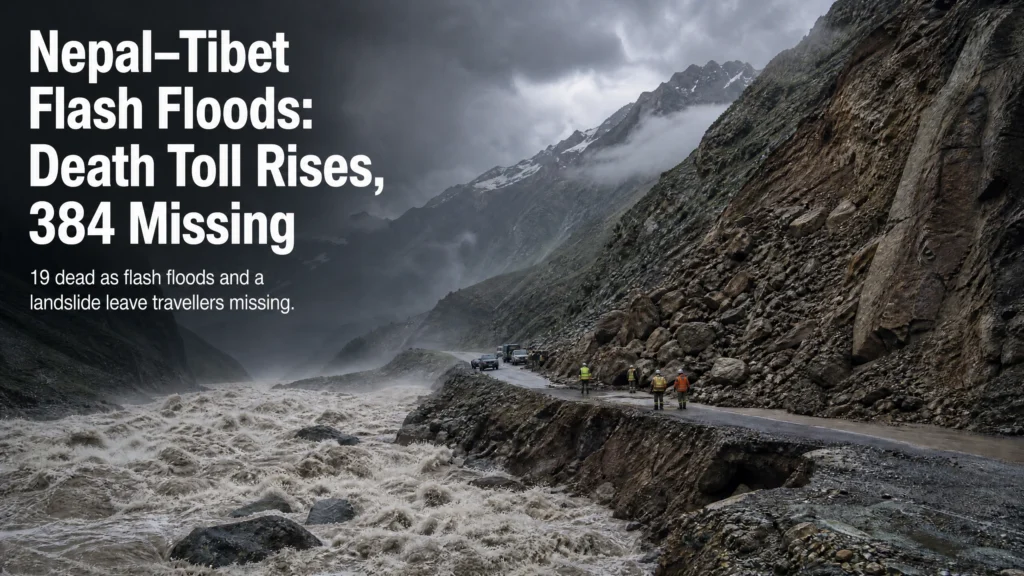
Nepal-Tibet Border Flash Floods: Death Toll Rises to at Least 19, 384 Travellers Missing. What We Know So Far
A devastating flash flood triggered by an avalanche and mudslide on the Himalayan border between Nepal and Tibet has left at least 19 people dead in Nepal, with the toll expected to rise further, and 384 travellers unaccounted for, according to Nepali authorities. Chinese state media has separately reported “major casualties” on the Tibetan side of the border, in the county of Gyirong. This is a still-developing disaster, and figures are being updated by officials on both sides as search and rescue operations continue. Here is a factual summary of what is known so far.
What Happened
On Wednesday, 26 August 2026, a wall of mud, rock and water broke loose along the Bhote Koshi river, which flows from Tibet into Nepal, near the two countries’ shared border. Verified videos showed dozens of people being swept away, and both Nepali and Chinese authorities have warned that the final casualty and damage figures could be significantly higher than what is currently confirmed. Nepal’s Prime Minister has ordered evacuations from riverside areas, and China’s President Xi Jinping has called for an “all-out” search and rescue effort.
Death Toll and Missing Persons
As the disaster has unfolded through the day, reported figures have risen. Early reports on Wednesday morning cited at least nine deaths in Nepal; by the afternoon, Nepal Police put the confirmed toll at least 19, with officials cautioning that this number is likely to increase as rescue teams reach affected areas.
Nepal’s tourism board reported that 384 travellers were unaccounted for, of whom 291 were foreign nationals. Those reported missing include 105 Indians, three US citizens, 12 British nationals, an Australian, Malaysians, and separately, South Korean news agency Yonhap reported around eight South Korean nationals also unaccounted for. The remaining missing travellers were Nepali citizens.
On the Chinese side, state broadcaster CCTV reported “major casualties and missing people” at the Gyirong Port, a border trade crossing in Tibet’s Shigatse region, without providing a specific death toll at the time of reporting.
What Triggered the Disaster
The precise cause is still being investigated, but the leading explanation points to a rock-ice avalanche in the Lhende Khola river on the Nepali side of the border, which blocked the river’s flow before the resulting buildup burst downstream as a flash flood. Experts at the Kathmandu-based International Centre for Integrated Mountain Development (ICIMOD) say this cascading blockage-and-burst pattern is consistent with what was observed.
Separately, the German Research Centre for Geosciences (GFZ) recorded a magnitude 4.4 earthquake in the area approximately seven minutes before the timestamp on security footage showing the flood’s onset. Nepal’s foreign minister told parliament that this earthquake may have triggered the avalanche, though officials on the ground in China said a preliminary assessment found no unusual activity specifically on their side of the border, and the exact chain of causation remains unconfirmed.
Where the Flood Hit: Rasuwa and Gyirong
On the Nepali side, the worst-affected areas are Syabru Besi and Timure, in the mountainous Rasuwa district, home to roughly 50,000 people. Rescue helicopters have been unable to land in some of these areas because the river is flowing well above its normal course. Local accounts describe entire riverside settlements being swept away.
On the Chinese side, the mudslide struck the Gyirong land port, cutting roads, communications and power links in the surrounding Shigatse region of Tibet. Authorities said the debris that hit the crossing had surged upstream from the Nepali side.
Impact on Infrastructure
Nepal’s Electricity Authority said roughly 430 megawatts of power generation capacity was damaged, including hydropower and solar facilities, which amounts to more than 12% of Nepal’s total national hydropower capacity of 3.2 gigawatts. Several highways in the region have also been closed. Downstream, flood alerts have been issued in India’s Uttar Pradesh and Bihar states, since the Bhote Koshi feeds into Nepal’s Trishuli river, which eventually flows into India as the Gandak river.
Also Read >>>> Pasindu Sooriyabandara Falls for 92, Misses Maiden Century
Rescue and Government Response
Nepal: Prime Minister Balendra Shah has ordered police and military personnel to join rescue operations and directed the evacuation of people living in low-lying areas near the river.
China: President Xi Jinping called for an all-out search for the missing, alongside stronger early-warning systems to prevent secondary disasters. State broadcaster CCTV reported that at least 574 rescuers had been deployed to the Gyirong crossing, though a responder told CCTV it could take at least four hours to reach the site due to sediment up to 1.5 metres deep blocking access routes.
India: Prime Minister Narendra Modi said India was ready to provide humanitarian assistance, and rescue teams from Nepal and China are coordinating closely on the ground.
Risk of a Second Flood
Experts have warned that the danger is not yet over. Qianggong Zhang, head of climate and environmental risks at ICIMOD, said a blockage remains lodged upstream on the Nepal-China border river, and that a second flood event may still occur. Authorities in Tibet’s Shigatse prefecture have separately warned that local roads remain at risk of further mudslides and are currently unsafe for travel.
A Similar Disaster Last Year
This is not the first time the Bhote Koshi river has caused deadly flooding in the region. A flood along the same river in 2025 killed nine people and left 24 missing, and washed away the “Friendship Bridge” connecting Nepal and China, disrupting cross-border trade and transport for months. That earlier flood was attributed to a supraglacial lake draining in Tibet. Separately, in July 2025, 17 people went missing after another mudslide near the Gyirong Port. Scientists point to climate change as a factor increasing the frequency and intensity of such extreme events across the Himalayan region.
Frequently Asked Questions (FAQs)
Q1. How many people have died in the Nepal-Tibet border flood?
As of the latest update, Nepal Police have confirmed at least 19 deaths, up from an earlier reported toll of nine. Officials expect the number to rise as rescue operations continue. China has reported “major casualties” on its side without providing a specific figure.
Q2. How many people are missing?
Nepal’s tourism board reported 384 travellers unaccounted for, including 291 foreign nationals such as 105 Indians, 12 British nationals, three US citizens, an Australian and Malaysians, alongside Nepali citizens. Around eight South Korean nationals were separately reported missing.
Q3. What caused the Nepal-Tibet flood?
The leading explanation is a rock-ice avalanche in the Lhende Khola river on the Nepali side, which blocked the river before bursting into a flash flood. A magnitude 4.4 earthquake was recorded shortly before the event and may be linked, though this is not yet confirmed.
Q4. Where exactly did the disaster occur?
On the Nepali side, the Syabru Besi and Timure areas of Rasuwa district were worst affected. On the Chinese side, the Gyirong land port in Tibet’s Shigatse region was hit, cutting roads, power and communications.
Q5. Is there a risk of another flood?
Yes. Experts at ICIMOD have warned that a blockage remains lodged upstream on the border river, raising the risk of a second flood event.
Q6. Has this happened before in this area?
Yes. A flood on the same Bhote Koshi river in 2025 killed nine people and washed away the Nepal-China “Friendship Bridge,” disrupting trade for months.
Note on this article: This is a rapidly developing disaster, and casualty figures, missing persons counts, and Nepali and Chinese authorities are updating damage assessments as rescue operations continue. This article reflects verified reporting as of the update time stated above; please refer to official government sources or major news agencies for the most current figures.


Pingback: Nepal Stock Market Flash Flood Impact: NEPSE Falls as Hydropower and Insurance Stocks Crash - Equity Munch