
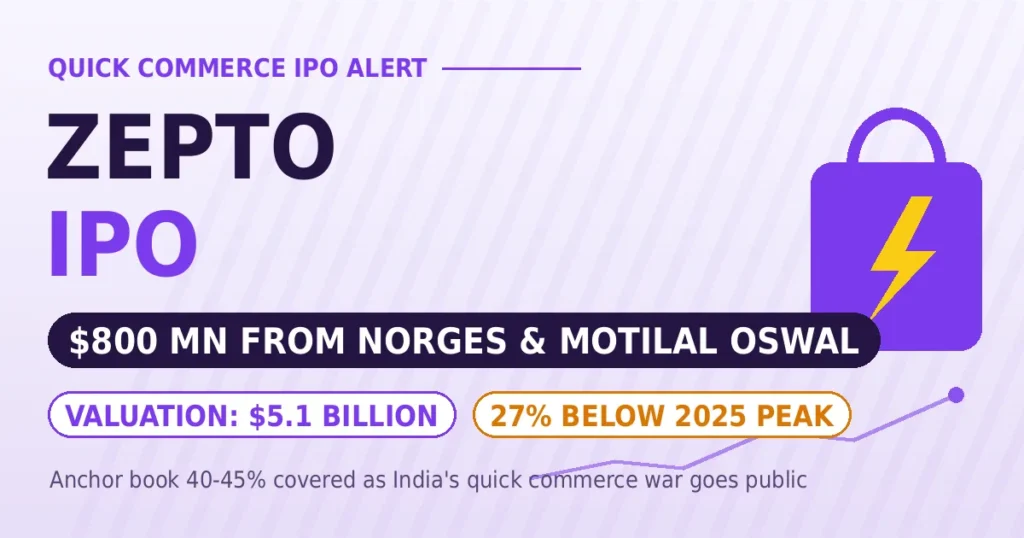
Zepto IPO: Norges and Motilal Oswal Set to Invest $800 Million, Post-Listing Valuation Seen at $5.1 Billion
One of India’s most awaited startup listings is taking shape. Quick commerce major Zepto has received bids for its IPO from multiple funds of Norges, including the Norwegian sovereign wealth fund, along with Motilal Oswal and other investors, according to a report citing people familiar with the matter. Together, the two investors are set to put in about $800 million and could cover 40 to 45% of Zepto’s anchor book. But there is a twist: Zepto is going public at a valuation of around $5.1 billion, roughly 27% below the $7 billion tag it commanded in October 2025. Here is everything we know so far.
The $800 Million Anchor Bet
According to the report, funds linked to Norges and domestic financial powerhouse Motilal Oswal are together set to invest about $800 million in the Zepto IPO. One person cited in the report said the two could cover approximately 40 to 45% of the anchor book, an unusually large share that signals deep institutional conviction even before the issue formally opens.
The IPO process is still underway, and several large mutual funds have also shown interest in betting on Zepto as part of the company’s fundraising plan. Zepto, Norges and Motilal Oswal did not respond to Moneycontrol’s queries on the development.
Who Is Investing in the Zepto IPO
Norges manages Norway’s Government Pension Fund Global (GPFG), one of the world’s largest sovereign wealth funds. Notably, Norges is no stranger to Indian new-age companies: through funds like GPFG, it already holds investments in Eternal (parent of Blinkit) and Swiggy (parent of Instamart), both of which compete directly with Zepto in quick commerce. Its participation in Zepto would effectively give it exposure across all three major players in the space.
Motilal Oswal, one of India’s leading broking and asset management groups, joining the anchor book adds strong domestic institutional weight alongside the global sovereign money.
Also Read >>>> SBI Funds Management IPO: GMP, Price Band & Full Review
Zepto’s Valuation: $5.1 Billion Post-Money
As per the report, Zepto’s new pre-money valuation stands at $4.3 billion, with the post-money (post-listing) valuation at about $5.1 billion.
That number is significant because of what it is being compared with. In October 2025, Zepto was valued at $7 billion when US CalPERS and other investors put in $450 million. The IPO valuation of $5.1 billion is therefore roughly 27% below that private-market peak.
Why the Valuation Was Cut 27%
The report points to the usual suspects behind the markdown: Zepto’s continuous cash burn, ongoing questions about its path to profitability, and other operating metrics that public market investors scrutinize far more harshly than private backers do.
Zepto is not alone in this. Indian new-age companies have repeatedly priced their public offerings below their private-market valuations to leave room for listing-day appetite, and the report notes that companies including Meesho have taken the same route. A lower entry valuation shifts risk from IPO subscribers back to late-stage private investors, that is often read as a healthier setup for the stock’s public debut.
The Quick Commerce Battlefield
Zepto’s listing will be the first pure-play quick commerce IPO in a market where the war is already three-sided: Blinkit (owned by Eternal), Swiggy Instamart and Zepto. Interestingly, with Norges already invested in Eternal and Swiggy, the sovereign fund’s Zepto bet means it now has skin in the game across the entire sector rather than picking a single winner. For investors, Zepto’s public financials will finally offer a direct, audited look at quick commerce unit economics that until now could only be inferred from Eternal’s and Swiggy’s segment disclosures.
What This Means for IPO Investors
Three takeaways from the development:
First, a 40 to 45% anchor book commitment from just two institutions is a strong demand signal, and large mutual fund interest suggests the anchor round could be heavily subscribed. Second, the 27% valuation haircut shows the company and its bankers are pricing for a successful listing rather than a maximum raise, which has historically improved listing-day outcomes for new age IPOs. Third, the cash burn and profitability questions that forced the markdown have not gone away, so post listing performance will depend on the numbers Zepto shows in its first few quarters as a public company.
The IPO process is still in motion, and formal details such as the price band, lot size, and issue dates are yet to be announced. We will update this post as soon as they are.
Frequently Asked Questions (FAQs)
Q1. Who is investing in the Zepto IPO?
According to a report, multiple Norges funds, including the Norwegian sovereign wealth fund, along with Motilal Oswal, have placed bids and are set to invest about $800 million, potentially covering 40 to 45% of the anchor book. Several large mutual funds have also shown interest.
Q2. What is Zepto’s IPO valuation?
Zepto’s new pre money valuation is $4.3 billion, and its post money valuation is about $5.1 billion, according to the report.
Q3. Why is Zepto’s valuation lower than before?
The $5.1 billion post-money valuation is about 27% below the $7 billion valuation set in October 2025, when US CalPERS and others invested $450 million. The markdown reflects concerns over cash burn and profitability that public market investors weigh heavily.
Q4. When is the Zepto IPO opening?
The IPO process is still underway and official dates, price band and lot size have not been announced yet. This post will be updated once Zepto files the details.
Q5. Who are Zepto’s competitors?
Zepto competes in quick commerce with Blinkit (owned by Eternal) and Swiggy Instamart. Norges already holds investments in both Eternal and Swiggy.
Q6. Have other startups listed below their private valuations?
Yes. Indian new age companies, including Meesho, have priced public issues below their private market valuations to improve listing prospects


Pingback: NBCC Share in Focus: HSCC Merger Approved, What It Means - Equity Munch
Pingback: LSE 24: London Stock Exchange’s 24-Hour Trading Explained - Equity Munch
Pingback: Delhi Lakshmi Yojana: Rs 2,500 Monthly, How to Apply Online - Equity Munch