
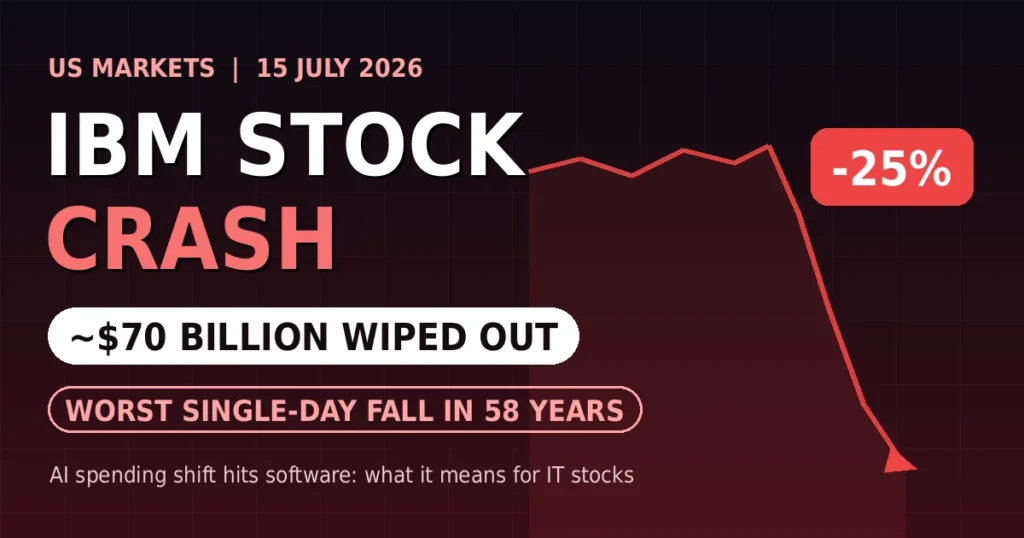
IBM Stock Crash Explained: Why Shares Fell 25% in a Day, Wiping Out Nearly $70 Billion, and What It Means for IT Stocks
IBM just suffered one of the most brutal single day sell offs in Wall Street history. The 115 year old technology giant’s shares plunged 25% on Tuesday after it released disappointing preliminary second-quarter numbers, erasing between $67 billion and $70 billion in market value in a single session. It was the stock’s worst one-day fall in at least 58 years, a decline even sharper than what IBM shareholders endured during the 1987 Black Monday crash. The shock waves reached Dalal Street too, where Infosys, TCS, and Persistent Systems led losses on the Nifty IT index. Here is a complete breakdown of what happened, why, and what it means for tech investors.
What Happened to IBM Stock
The IBM shares plunged 25% to $217.07 on Tuesday after the company warned that its preliminary second quarter results would miss Wall Street expectations. According to Bloomberg data, it was the biggest single-day loss since at least 3rd January 1968, the earliest date for which pricing data on the stock exists, making it the worst session in at least 58 years and arguably in the company’s 115 year history.
The fall wiped out roughly $67 billion to $70 billion from IBM’s market capitalisation, which stood at about $272.78 billion before the warning.
The Numbers Behind the Crash
The preliminary numbers that triggered the panic:
Revenue: About $17.2 billion for the June quarter, up just 1% year-on-year, the company’s weakest growth in over a year, and below analyst estimates of roughly $17.9 billion (LSEG consensus at $17.86 billion).
Earnings per share: Preliminary EPS of $2.93 against estimates of $3.01.
Infrastructure division: Revenue fell 7%, with the flagship Z mainframe line accounting for much of the shortfall. Mainframes are the high-powered computers used by banks, airlines and large corporations to process millions of transactions.
Software: Revenue grew 5%, but still came in below expectations.
Also Read >>>> Wipro Q1 Results on 16 July: Dividend, Expectations, Preview
Why IBM Crashed: The AI Spending Shift
The core reason is a sudden change in how big companies are spending their technology budgets. The global rush to build artificial intelligence infrastructure has sent demand for servers, memory chips and storage soaring, driving up prices and creating supply shortages across the industry.
IBM said that in the last few weeks of June, many of its large corporate customers abruptly rewrote their budgets and rushed to buy hardware to get ahead of expected price increases. That shopping spree pulled spending away from IBM’s higher-margin mainframe computers and related software.
CEO: Arvind Krishna admitted the miss in a letter to investors, writing that “we faltered” and did not adapt and move quickly enough. He explained that clients shifted their quarterly capex toward servers, storage, and memory purchases to secure supply constrained infrastructure, and that while IBM had anticipated some supply-chain impact, it did not anticipate the magnitude of the capex reprioritisation. Several large deals also failed to close on expected timelines.
The bigger message for markets: enterprise technology budgets are a fixed pool of money, and right now that money is rotating out of traditional software and into AI hardware. Companies selling memory and hard-to-replicate hardware retain pricing power, while everyone else competes for whatever budget remains.
The Cybersecurity Factor
A second drag on the quarter was cybersecurity. Krishna said businesses were prioritizing security spending because AI has made cyberattacks more sophisticated. These concerns intensified after the release of Anthropic’s advanced Mythos AI model, which has demonstrated the ability to uncover vulnerabilities in existing software, networks and encryption systems.
As clients diverted previously planned project budgets into cyber defences, security stocks soared: CrowdStrike jumped 12%, while Okta and Netskope surged about 11% each.
SaaS Stocks Under Pressure
IBM’s warning reignited fears about traditional software companies, the Software as a Service pack that includes names like Salesforce, Adobe and Intuit. After the announcement, Microsoft, Service Now, Salesforce and Intuit fell between 2% and 5%, though some clawed back losses later in the day.
The episode revives the “SaaS pocalypse” debate from earlier this year, when Wall Street briefly panicked over predictions that AI models could replicate much of what everyday software subscriptions offer.
The Bright Spots in IBM’s Numbers
Not everything in the preliminary release was bad:
Red Hat, IBM’s open-source software unit that lets companies run applications across multiple cloud providers, posted 11% revenue growth.
The company’s server and storage business outside mainframes surged 37% as clients snapped up exactly the kind of AI-adjacent hardware that hurt its mainframe line.
IBM also announced Lightwell, a $5 billion initiative to fix vulnerabilities in open-source software, backed by major banks including Bank of America, JPMorganChase and Goldman Sachs, and highlighted its more than $10 billion of investments in quantum computing along with AI partnerships, including with OpenAI, though these remain at an early stage.
Impact on Indian IT Stocks
The tremors reached Indian markets on Wednesday, 15th July. IT stocks fell up to 1%, with Infosys, Persistent Systems, and TCS leading the losses on the Nifty IT index.
The damage was cushioned, however, by softer-than-expected US inflation data for June, which lifted overall Indian equities. At 9:35 am, the Sensex and Nifty were trading 0.7% higher, as lower US inflation eases dollar pressure and supports foreign flows into emerging markets like India.
Valuation watchers note that the Nifty IT index is already trading at a price-to-earnings ratio of about 18.8, a nearly 30% discount to its seven-year median of 27.12, according to Nishchal Jain, Quant Researcher at Share. Market by PhonePe. That deep discount reflects the same global enterprise tech spending headwinds that just hit IBM.
What Analysts Are Saying
Analysts described the episode as an ugly moment for IBM and for software stocks broadly. Chris Beauchamp, chief market analyst at IG Group, noted that the key question is how long the spending shift toward infrastructure and cybersecurity lasts: a few more months might be bearable, but anything longer would raise serious questions about software stocks all over again.
What Happens Next
IBM will report its full second-quarter results on 22 July, and that release will show whether the June capex shift was a one-quarter shock or the start of a lasting rotation. For Indian IT investors, the results and management commentary from TCS, Infosys, HCLTech and Wipro this earnings season will reveal how much of the global budget reallocation is hitting Indian services players.
Frequently Asked Questions (FAQs)
Q1. Why did IBM stock crash 25%?
IBM warned that preliminary Q2 revenue of about $17.2 billion would miss estimates of $17.9 billion, as large customers abruptly shifted spending from mainframes and software to AI servers, memory and, storage in late June, and as cybersecurity worries diverted budgets.
Q2. How much money did IBM lose in the crash?
The 25% fall erased between $67 billion and $70 billion of IBM’s market capitalisation, which was about $272.78 billion before the warning
Q3. Was this IBM’s worst stock fall ever?
It was the biggest single day loss since at least 3 January 1968, based on Bloomberg pricing data, making it the worst in at least 58 years and sharper than IBM’s fall during the 1987 Black Monday crash
Q4. What did IBM CEO Arvind Krishna say?
In a letter to investors, Krishna admitted the company faltered and did not adapt quickly enough, saying IBM did not anticipate the magnitude of clients reprioritizing capex toward supply constrained AI infrastructure
Q5. How did the IBM crash affect Indian IT stocks?
On 15th July, Indian IT stocks fell up to 1%, with Infosys, Persistent Systems and TCS leading Nifty IT losses, though the broader Sensex and Nifty rose 0.7% on soft US inflation data.
Q6. When will IBM report full Q2 results?
IBM is scheduled to report its complete second-quarter results on 22 July 2026.
Q7. Which stocks gained from IBM’s warning?
Cybersecurity stocks rallied, with CrowdStrike up 12% and Okta and Netskope up about 11% each, as companies divert budgets toward cyber defenses.


Pingback: ICICI Bank Q1 Results Preview: Profit, NII & Key Estimates - Equity Munch